What is your cleaning business worth?
Tell us what you know. Move the sliders to your best estimate and we'll do the math.
No email required.
What you spend directly to deliver the product or service.
Payroll, rent, vehicles, insurance, office costs and other operating expenses.
Salary, payroll taxes, benefits and other compensation paid to the owner.
$750,000 − $300,000 − $250,000 − $100,000 = $100,000
Revenue, minus direct costs, minus overhead, minus your pay.
Profit plus the $100,000 you pay yourself — the earnings a buyer would actually value.
An estimate based on the numbers you set, not a review of your books.
Most small businesses sell in a low single-digit multiple. Which one applies depends on risk, not on what you want.
$200,000 owner earnings × 3.0x multiple
An educational estimate. Not an appraisal, a valuation opinion, tax advice, or a promise of what a buyer will pay.
An estimate from the numbers you set. Not a certified appraisal. Your basic number is free — no email needed.
What moves your value?
At 3.0x, every $1 of SDE is worth $3 of value.
Want a better estimate?
Add exact figures from your return or P&L — reported profit, owner pay, interest, taxes, depreciation and add-backs.

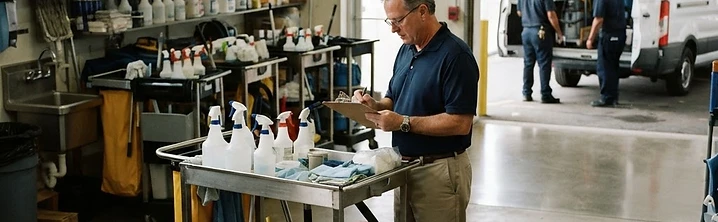
How to sell a cleaning or janitorial business
Janitorial value sits in signed commercial contracts and supervisors who run the shifts. Residential one-offs and crews that only work because you drive them add very little to a price.
Educational information only — not an appraisal, and not financial, tax or legal advice. No signup required to read this guide.
How cleaning and janitorial companies generally sell
Mostly a multiple of normalized earnings, with contracted commercial revenue and a supervisor structure doing most of the work.
Signed commercial contracts that renew, supervisors who run the crews, low customer churn, and labor that is properly classified and insured.
One-account dependence, owner-run crews, and labor practices that a buyer cannot inherit.
Find out what a buyer would check before they pay for your customer book.
The detail behind each line is below. What buyers like and fear, how these are valued, or the mistakes to avoid first.
What buyers pay for in cleaning and janitorial companies
Buyers are not paying for the work you do. They are paying for the parts of the business that keep producing after you leave.
- Contracted commercial revenue
Recurring contracts with renewal terms are the core asset. Buyers want to see the agreement, the scope and the renewal history, not just a client list.
- A supervisor layer
Working supervisors who run quality checks and cover call-outs. This is what makes the routes transferable rather than dependent on you.
- Low churn and clean margins
Customer retention over several years, with gross margin per account tracked well enough to know which contracts are worth keeping.
- Compliant labor
Properly classified employees or subcontractors, workers compensation, and payroll that matches the hours actually worked.
- Density by building and by shift
Accounts clustered geographically, ideally serviced in the same shift window, so each supervisor can cover more revenue.
- Supplies and equipment managed as cost
Chemical usage and equipment maintenance tracked, not left to whichever crew buys what it likes.
What a buyer likes, and what makes them nervous
A cleaning buyer is underwriting a contract book and a supervision layer. Both answers come from documents: the agreements in the file, and the person who answers the phone when a client complains.
- • Written commercial contracts with renewal terms and two or more years of history
- • A working supervisor per route group who covers call-outs without you
- • Gross margin per account, so the buyer can see which contracts actually earn
- • Employees properly classified, insured and on payroll
- • Accounts clustered by building and shift so one supervisor covers more revenue
- • One property manager or office park at a fifth of revenue or more
- • Handshake accounts with no signed scope or renewal date
- • Crews that only function because you drive, clean and inspect
- • Contractors on 1099, no workers compensation, or overtime handled informally
- • Contracts priced years ago that now barely cover wages and supplies
What a buyer checks to confirm each of these is in what a buyer will scrutinize.
What can quietly reduce what your business is worth
Each of these shows up as a lower multiple long before a buyer makes an offer. The reason is one line; the detail is optional.
- One customer is the business
A single office park or property manager is a large share of revenue and can be lost on one procurement decision.
- No contracts, just relationships
Handshake arrangements, verbal scopes and annual goodwill.
- You run the crews
You cover call-outs, inspect buildings and handle every complaint. Supervisors have no authority.
- Labor practices that create liability
Workers paid cash, misclassified contractors, no workers compensation, or overtime handled informally.
- Margin hidden by unpaid owner labor
The company looks profitable because you and family members work for free and drive your own vehicles.
- Accounts that lose money quietly
Long-standing contracts priced years ago that now barely cover labor and supplies.
- The contract says the account leaves when you do
Many commercial cleaning agreements include a termination or re-bid right on change of ownership, or require the client consent to assignment. Owners rarely read those clauses because they never mattered before.
Confessions of a Cleaning Business Owner: Start, Scaling and Selling a Cleaning Business
A cleaning company owner on going from solo work to a sellable operation, including the parts of the business that had to leave his hands before a sale was realistic.
- What had to leave the owner’s hands first
- How client contracts were structured
- What the sale process exposed
In contract cleaning the asset is the agreement book and the supervisor layer that holds it. Both have to exist before a buyer pays for anything else.
External media opens on the creator’s own platform. BizSellerHQ does not endorse every opinion expressed by an outside creator, and nothing here replaces your own adviser.
How cleaning and janitorial companies are valued
Cleaning and janitorial companies are valued on seller discretionary earnings, with revenue used as a cross-check and contract quality weighted heavily.
Buyers move quickly to two questions: how much of the revenue is contracted, and can the crews run without the owner. Both are usually fixable before a sale.
The metric buyers use: SDE for owner-operated companies. Where supervisors and managers exist, buyers may also look at EBITDA and at revenue per supervisor.
Across 797 reported national cleaning and janitorial sales, half of closed deals sat between 1.57x and 2.66x owner earnings, with the median at 2.07x and the average at 2.19x. The 2025 median sale price reached $325,000, a 62.5 percent increase over 2021.
BizBuySell national cleaning and janitorial business valuation benchmarks. Reported sales 2021–2025. National reported transactions, not local comps, and not every sale is reported.
A median reported sale near $260,000 on about $136,000 of owner earnings describes a company around $433,000 in revenue with a supervisor or two. The average earnings multiple rose from about 2.0x in 2021 to 2.3x in 2025, and the average revenue multiple rose faster, from 0.62x to 0.78x, because margins thinned: buyers were paying more per dollar of revenue and less per dollar of profit.
Written contracts with renewal terms, a supervisor per route group, accounts clustered for density, compliant payroll and insurance, and margin per account that has been reviewed rather than assumed.
One property manager dominating revenue, verbal scopes, owner-run crews, 1099 labor, contracts that re-bid on change of ownership, and accounts that have not been repriced since they were won.
Closed sales landed at roughly 88 percent of asking on the reported medians, while the source reports an average of about 0.91 across individual transactions. The gap between 2.07x on closed sales and 2.22x on asking prices is modest, so a well-contracted company can defend its number while an owner-dependent one gets argued down on the multiple instead.
Sale price is not the same as what you keep
Cleaning companies usually carry little equipment debt and a lot of payroll risk. Both affect what you actually keep.
Accrued wages, payroll taxes and any outstanding workers compensation premium adjustment are settled before you are paid.
Broker commission, attorney and accounting costs, plus a quality-of-earnings review in larger deals.
Asset allocation between equipment, supplies and customer relationships changes the tax. Confirm the structure with your CPA.
Prepaid services, customer deposits and any billing in arrears are usually settled at closing.
Holdbacks for customer retention are common where contracts renew annually.
Often needed because many buyers are operators with limited capital. It is deferred money, not headline price.
What a buyer will scrutinize
These are the five things that decide most of the conversation. The rest is depth, and it only matters after the first five are answered.
- Contract register: start dates, scopes, pricing, renewal and assignment terms
- Customer concentration and churn, by account and by year
- Labour classification, payroll, workers compensation and certificates of insurance
- Supervisor structure and who actually covers call-outs
- Gross margin by account, including the ones you would rather not discuss
The top reasons cleaning and janitorial companies become hard to sell
Almost every stalled sale comes back to one of three things. None of them are about the quality of the work you do.
- 1The customer book is not under contract
Relationships and verbal scopes do not survive a change of owner. Buyers need agreements they can enforce and renewal evidence.
- 2Everything depends on the owner covering shifts
A company that runs because you clean, drive and inspect has no transferable operating layer.
- 3Labor practices a buyer will not inherit
Cash labor, misclassification or missing insurance will end a transaction in diligence, regardless of how good the earnings look.
The actions that reduce these risks are laid out further down, in the mistakes to avoid and what to do by timeline.
Mistakes that cost owners money before they list
Each of these is fixable. Each one becomes expensive when a buyer discovers it during diligence instead of the owner fixing it beforehand.
- 1Running verbal accounts for years
A book of relationships is not a book of contracts. Convert your largest accounts to written agreements with a scope, a price and a renewal date before you list, because a buyer pays for what can be enforced after your relationship ends.
- 2Bidding to win, then never repricing
Long-standing accounts priced years ago often lose money once wages move. Review margin by account and either reprice or exit the losers; carrying them lowers the earnings a buyer is willing to multiply.
- 3Staying the supervisor yourself
If you cover call-outs and inspect buildings, there is no operating layer to sell. Promote a working supervisor, give them authority over the shift, and let a buyer see somebody other than you answer a complaint.
- 4Treating worker classification as paperwork
Cash labor, 1099 crews and missing workers compensation end transactions in diligence rather than reducing the price. Fix classification and insurance a year out, because the cleanup is slow and every buyer asks.
How these businesses usually change hands
The structure decides how much you get at closing and how much depends on what happens afterwards.
- SBA-financed individual buyer
Common for companies with several supervisors and contracted revenue. Lenders look at contract retention and labor compliance.
- Seller note
Frequently required, since the buyer pool is made up of operators rather than institutions.
- Strategic cleaning company
Pays for account density and supervisor coverage. Often the cleanest buyer where routes overlap.
- Private equity platform
Realistic only with real scale, supervisors and EBITDA. May involve rollover equity.
- Management buyout
A working supervisor or operations manager buying the contracts over time. Common and often the smoothest transition.
- Asset sale
Used where contracts are weak or liabilities need to stay behind. Usually prices lower.
A structure being common does not make it right for you. Which one you accept is a decision about risk, timing and tax — not a market rule.
What matters depends on when you want to sell
The same business needs different work at different distances from a sale. Start with the column that matches your timing.
- • Convert verbal accounts into written contracts
- • Put a working supervisor on every route group
- • Fix classification and insurance
- • Track gross margin by account
- • Clean three years of records and add-backs
- • Exit or reprice the accounts that lose money
- • Reduce dependence on your largest customer
- • Get an outside view of value and net proceeds
- • Confirm value and what you would actually keep
- • Prepare contracts, payroll and insurance for diligence
- • Line up CPA, attorney and any intermediary
- • Plan a transition that keeps supervisors in place
Sell with a broker or without one?
Cleaning companies are sold through general business brokers, franchise resale specialists and direct approaches. Ask how many janitorial businesses they have closed and how they intend to handle confidentiality with the crews, who will notice a stranger walking buildings.
Above roughly $2M of revenue, specialist facility-services intermediaries and strategic buyers are active. Below that, a local business broker or a sale to a neighbouring company that wants the density is realistic.
Choosing and Managing a Business BrokerThat lesson covers how intermediaries are paid, what to ask them, and what a good engagement agreement contains.
What you may find when you look closely
Not everything you find is bad news. The point of looking early is that the list is still fixable.
- Your customer book may be worth less than you think without written contracts
- One account may be carrying more risk than the revenue is worth
- Your margin may depend on unpaid owner hours
- A supervisor may add more to the price than another crew
- Your labor classification may stop a sale outright
- Your net proceeds may be absorbed by payroll and tax obligations
Questions these owners ask before they sell
Short answers. Where the answer depends on your state, your license or your lease, it says so rather than guessing.
Do I need written contracts to sell a cleaning company?
In practice yes. Almost every buyer and every lender prices contracted revenue and discounts or excludes handshake accounts. If your largest accounts are verbal, converting them is usually the highest-value work you can do in the year before a sale, and it is far cheaper than the discount for not doing it.
What if one client is 30 percent of my revenue?
You can still sell, but the multiple will be lower and some buyers will not proceed at all. The usual remedies are an earnout tied to that account renewing, a holdback, or waiting and growing around the client so the concentration falls before you list.
Can I sell with 1099 subcontractors instead of employees?
Some buyers will look, but lenders often will not, and a classification challenge is one of the few things that ends a deal outright. Cleaning is a sector where state agencies actively look at this. Converting crews to payroll is slow and expensive, which is why it belongs a year before a sale rather than during diligence.
How long does it take to sell a cleaning business?
Reported cleaning and janitorial sales spent a median of 165 days on market between 2021 and 2025, before preparation. If contracts need re-papering or labor classification needs fixing, add several months, because buyers will wait for those to be resolved rather than price them.
Will a buyer keep my cleaners and supervisors?
Supervisors usually stay because they are the reason the buyer is interested, and buyers often require them as a condition. Cleaners are a different question: the buyer inherits your wage rates, so if you have been paying below market to protect margin, expect the price to be re-run at market pay.
You found the gaps. Now work through them.
BizSellerHQ helps you turn what you found into a prioritized plan — one action at a time, in the order that changes the outcome most.
The valuation, proceeds and readiness tools work without an account. An account saves your plan, program progress and Academy notes.
If you are weighing a different trade or practice
Signed maintenance contracts and route density carry the value. Mowing won one truck at a time does not.
Management agreements, revenue per door and trust accounting decide the price. The owner roster is the asset.
The lease and the machines are most of the deal. Verified collections and utility costs decide the price.
Benchmarks on this page come from reported transactions and are market context, not an appraisal of your business. Values and proceeds are working estimates from figures you enter. Confirm anything material with a qualified accountant, attorney, or adviser before you act on it.